



 Verified owner



Florida DMV – Frequently Asked Questions
To obtain a Florida driver’s license (Class E), you must provide proof of identity, Social Security number, and Florida residential address (two documents). You must pass a vision and hearing test, complete the Traffic Law and Substance Abuse Education (TLSAE) course, and pass the driving skills test. If under 18, parental consent is required. Non-U.S. citizens must present valid immigration documents.
In Florida, a new Class E (auto) driver’s license costs $48. If you take the knowledge test, there’s an additional $10 fee. Commercial driver’s licenses (Class A, B, or C) generally range from $75–$81. Always verify current pricing on the FLHSMV site.
The minimum age for a learner’s permit in Florida is 15. After holding a learner’s permit for at least one year without any traffic convictions—and upon turning 16—you can apply for an intermediate license. Full driving privileges are granted at 18 with a full-privilege driver’s license.
Bring proof of identity (e.g., birth certificate or U.S. passport), proof of Social Security number (e.g., SSN card or W-2), and two proofs of Florida residential address (e.g., utility bill, bank statement). If your name has changed, include legal proof of the change. Non-U.S. citizens must present acceptable immigration documents.
Book online via the FLHSMV site or contact your local office. You must have held a learner’s permit for at least one year with no traffic convictions to be eligible for the driving test.
Be at least 15. Complete the TLSAE course, gather identity/SSN/address documents, then take vision and hearing checks plus the written exam on traffic laws and signs at a local FLHSMV office. Pay the required fee and obtain parental consent if under 18.
Before moving from a learner’s permit to a full license, you must complete 50 hours of supervised driving, including 10 hours at night. These hours build real-world experience before your road test.
Study the Florida Driver’s Handbook, practice with the same vehicle you’ll test in, and drill key maneuvers: full stops, signaling, lane positioning, merging, parking, and mirror/blind-spot checks. Consider a driver education course or instructor for targeted feedback.
Frequent mistakes include not checking mirrors regularly, failing to signal, incomplete stops, speeding, poor lane positioning, and misreading road signs. Keep calm, keep both hands properly on the wheel, and verbalize your checks if it helps you stay methodical.
Yes. Your vehicle must be in safe working condition (seat belts, mirrors, turn signals, brake lights, horn), insured, and registered. Bring proof of insurance and registration. You may also use a rental, but ensure the agreement allows testing and lists you as an authorized driver.
If you don’t pass, you must wait at least 24 hours before retaking the exam. After three failures, you must complete an additional driver education course before attempting again.
Yes. Under 18s face nighttime restrictions during the first year. For the first three months after licensing, driving is allowed during daylight hours only; after that, driving is allowed until 10 p.m. Restrictions end at 18.
No. You must apply in person at an FLHSMV office. However, you can complete required driver education courses online and schedule appointments online.
With a Florida learner’s permit, you are allowed to drive in Florida only. Other states have different rules—some may honor an out-of-state learner’s permit while others do not. Check the DMV in the state you plan to visit before driving there.
In Florida, a regular Class E driver’s license is generally valid for eight years. For drivers aged 80+, the license is valid for six years. Renew on time to stay legal.
Yes, you can renew online—but only every other renewal period. If you used online renewal last time, you’ll need to renew in person at a Florida DMV office for the next renewal.
Provide proof of legal presence in the U.S., identity, SSN (or acceptable alternative), and Florida address. Pass a vision test, written knowledge test, and driving test. Bring your foreign license and International Driving Permit if you have them (they do not replace Florida licensing).
A learner’s permit allows supervised driving (with restrictions on hours and supervision). A driver’s license grants independent driving privileges unless otherwise restricted by age or conditions.
Yes. Florida requires minimum visual acuity for licensing. If you need glasses or contacts to meet standards, a corrective-lenses restriction will be added to your license; additional evaluation may be required for lower acuity.
Yes, provided the rental meets safety and legal requirements. You must show the rental agreement with your name as an authorized driver and bring proof of insurance and registration.
You can retake the road test after 24 hours, subject to appointment availability. Use the time to practice and correct any issues that caused the failure.
Bring proof of identity (passport or birth certificate), proof of SSN (SSN card or W-2), and two proofs of Florida residential address (utility bills, bank statements). If under 18, parental consent is required.
Yes. The Florida knowledge exam is offered in multiple languages (e.g., Spanish, Chinese, Korean, Russian, and others). Availability can vary by office—confirm language options when you schedule.
You can retake the written test. After the first failure, a retesting fee applies for each additional attempt. If you fail the exam three times, you must complete an approved driver education course before retaking.
You may retake the Florida written test as early as the next day. After three failed attempts, you must complete a 4-hour Basic Driver Improvement (BDI) course before testing again.
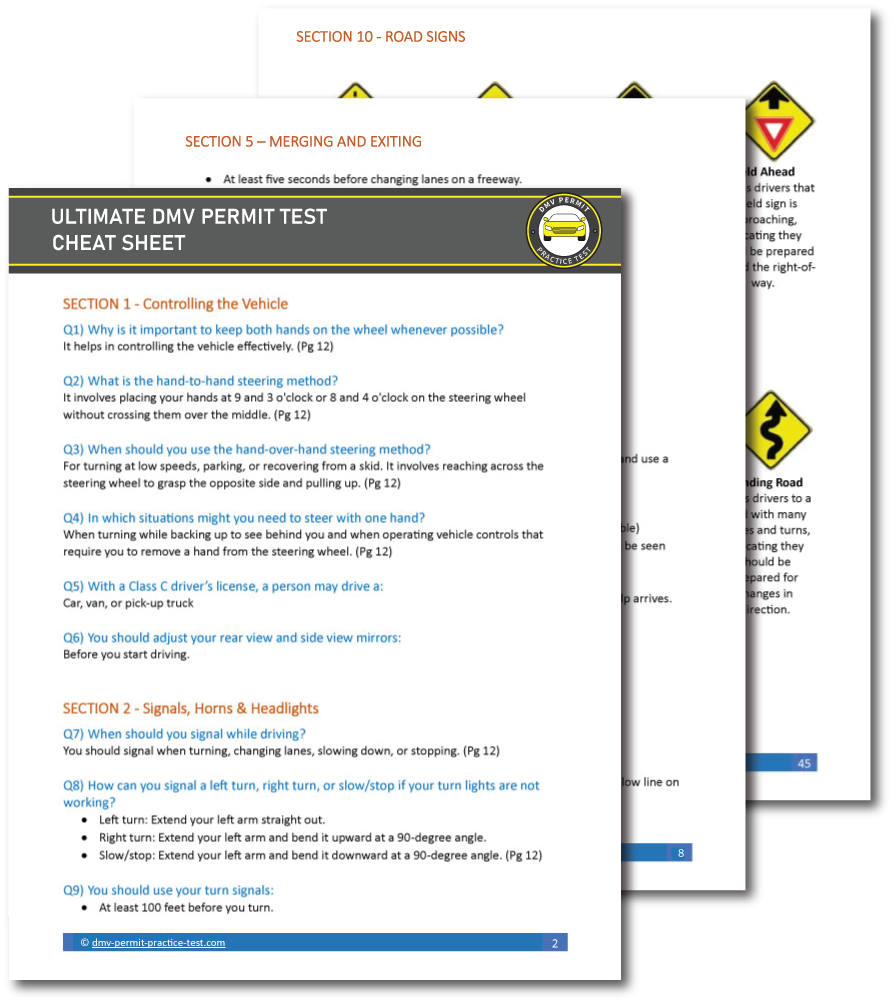
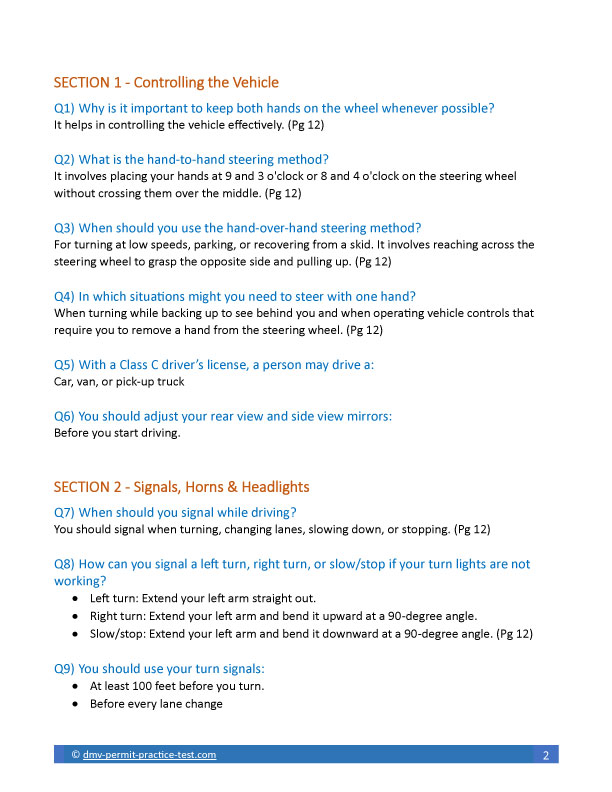
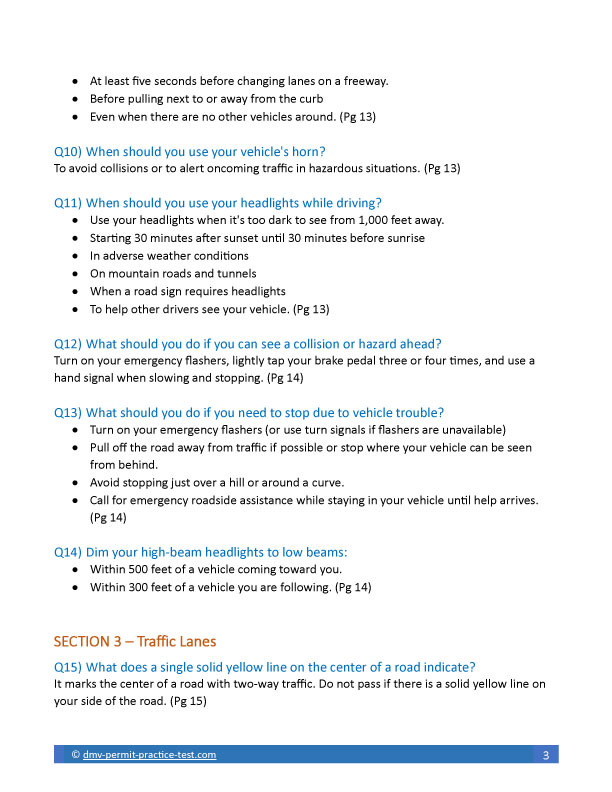
The Florida practice permit tests and cheat sheets you will find here are perfect for your Florida Learners Permit, Florida Driver’s License, FL Senior Citizens’ Refresher Test, and your FL Driver’s License Renewal. All questions are from actual DMV administered written permit tests that are submitted by your peers. The written portion of the official DMV test will cover information that is taken directly from the Florida Driver Handbook. It is designed to help you safely and effectively operate a motor vehicle. Questions will be based on rules of the road, traffic signs, and driving laws.
FL DMV Permit Exam at a Glance
You can expect to see 50 questions on your FL DHSMV exam. You must get 40 answers correct to pass your test. This represents an accuracy score of 80%. You must be a minimum of 14 years old to apply and take your DMV written test. To get your permit at the Florida DHSMV costs $48. This does not include the issuance of a permit test which is $25. and is part of your original license fee. To retake the knowledge exam is $10.