



 Verified owner


California DMV – Frequently Asked Questions
To get your first California driver’s license, you must apply through the California Department of Motor Vehicles (DMV) and meet age, permit, testing, and documentation requirements. In general, you must:
- Be at least 16 years old to get a provisional license (under the Graduated Driver License program) or 18+ for a full Class C license.
- Hold a California instruction permit for at least 6 months if you are under 18.
- If under 18, complete driver education and driver training and log at least 50 hours of supervised practice (10 at night) with a licensed driver age 25 or older.
- Pass a vision screening, written knowledge test, and behind-the-wheel driving test.
- Provide acceptable proof of identity, Social Security number (if eligible), and California residency (REAL ID or federal non-compliant).
- Pay the required application fee; the fee covers your written test, driver’s test, and license if issued.
New California residents must normally apply for a California driver’s license within a short time after moving to the state. Always review the latest DMV checklist before your visit, as requirements for teens, adults, and non-U.S. citizens differ.
California DMV driver’s license fees depend on the license type (Class C, commercial, motorcycle, etc.) and whether you are applying for an original license, renewal, or replacement. A standard noncommercial Class C driver’s license has a base application fee, while commercial and other license classes have higher fees.
Because DMV fees change over time—and may differ for original licenses, renewals, and special endorsements—you should always verify the current amounts directly with the California DMV before you apply, test, or renew.
California uses a Graduated Driver License (GDL) system with different age requirements for permits and licenses:
- 15½ years old: minimum age for a provisional instruction permit (after completing or being enrolled in driver education).
- 16–17 years old: minimum age range for a provisional driver’s license if you have held a permit at least 6 months, completed driver education and training, and met supervised practice requirements.
- 18+ years old: you can apply directly for a non-provisional Class C license without completing driver education or training, but you must still pass the knowledge, vision, and driving tests.
Teen drivers must follow additional restrictions on nighttime driving and passengers until they turn 18. Adults still need to meet all testing, documentation, and fee requirements.
When you apply for a California driver’s license, the DMV must verify your identity, Social Security number (if eligible), and California residency. Bring original or certified documents (no photocopies). Typically, you will need:
- Proof of identity & legal presence: such as a valid U.S. passport, certified U.S. birth certificate, Permanent Resident Card, or acceptable immigration documents (for non-U.S. citizens or AB 60 applicants).
- Social Security number: your SSN card, W-2, 1099, or other official document showing your full SSN—unless you are applying for an AB 60 license without SSN.
- Two proofs of California residency: a utility bill, rental or lease agreement, mortgage statement, bank statement, or other mail showing your name and California address.
- For REAL ID: specific identity and residency documents that meet federal Real ID standards.
- For applicants under 18: certificates of completion/enrollment for driver education and driver training, and a parent/guardian signature on the application.
Document requirements vary depending on whether you are applying for a standard license, REAL ID, or AB 60 driver’s license. Use the DMV’s document guide or checklist to confirm exactly what to bring.
To schedule a behind-the-wheel driving test with the California DMV, you generally need a valid instruction permit and a completed online or paper application. Then:
- Visit the DMV online appointment system and choose a “Driving Test” or “Behind-the-Wheel Drive Test” appointment.
- Select a convenient DMV field office, date, and time from the available slots.
- Confirm your appointment and keep your confirmation number or email.
You can also schedule a driving test by phone, but online booking is usually faster. On test day, arrive early with your permit, required documents, and a safe, properly insured vehicle that meets DMV test requirements.
In California, a learner’s permit is called a provisional instruction permit for most teen drivers. To get one, you must:
- Be at least 15½ years old and under 18.
- Complete or be enrolled in a DMV-approved driver education course.
- Fill out the online driver license/ID application and make a DMV office appointment.
- Provide proof of identity, Social Security number (if eligible), and California residency.
- Have a parent or guardian sign your application.
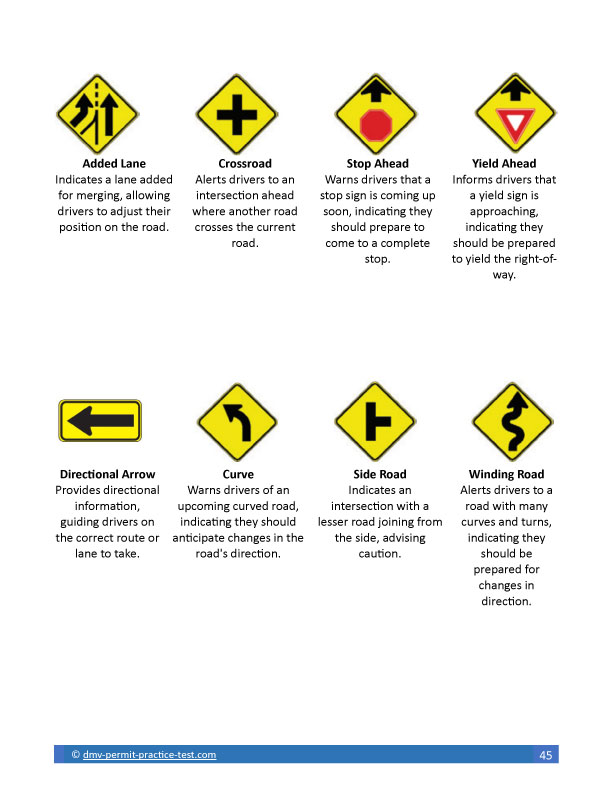
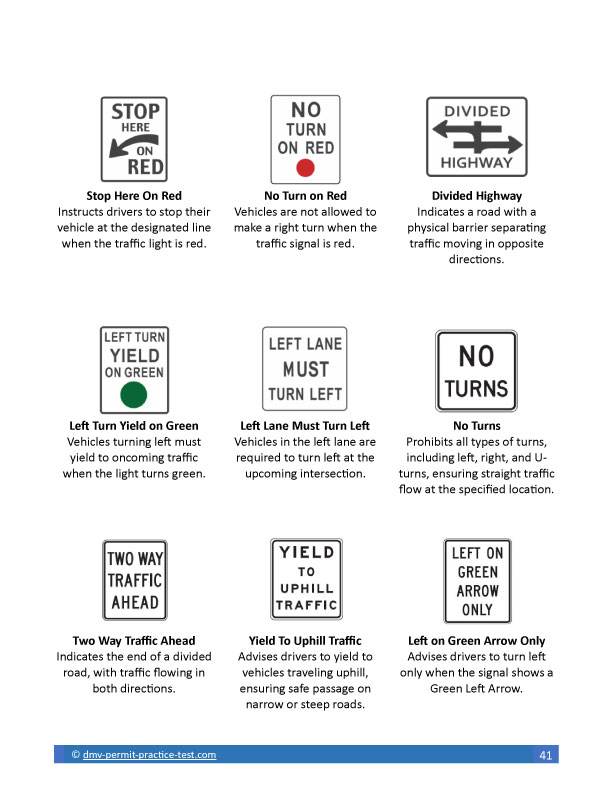
- Pass a vision exam and the knowledge test on California traffic laws and road signs.
- Pay the permit application fee.
Once you receive your instruction permit, you may drive only when supervised by a California-licensed driver who is at least 25 years old and seated beside you. Teens must also complete at least 6 hours of professional behind-the-wheel training with a licensed instructor.
For most teen drivers, California’s Graduated Driver License law sets specific practice-hour requirements before you can take the driving test:
- If you are under 18, you must complete at least 50 hours of supervised driving with a licensed driver age 25 or older.
- At least 10 of those hours must be at night.
- You must hold your instruction permit for at least 6 months before you can schedule the behind-the-wheel drive test.
- In addition, you must complete 6 hours of professional behind-the-wheel training with a licensed driving instructor.
Although adults 18 and older do not have a specific minimum hour requirement, the DMV strongly recommends extensive supervised practice in many types of traffic, road, and weather conditions before attempting the drive test.
To prepare for the California driving test, focus on both knowledge and real-world driving skills:
- Study the California Driver Handbook carefully, paying special attention to right-of-way rules, speed limits, lane use, and parking laws.
- Practice driving often with a licensed driver, including city streets, freeways, residential areas, and night driving.
- Master key maneuvers such as parallel parking, three-point turns, smooth lane changes, backing in a straight line, and proper stopping at limit lines.
- Use a safe, well-maintained vehicle with working lights, signals, horn, and brakes.
- Take online practice tests for the written exam so you understand California’s traffic laws and road signs.
On test day, arrive early, stay calm, listen carefully to the examiner’s directions, and focus on safe, defensive driving rather than just “passing the test.”
Many California DMV drive test failures are caused by avoidable errors. Common mistakes include:
- Rolling stops at stop signs or right turns on red instead of coming to a complete stop.
- Not yielding to pedestrians, bicyclists, and other vehicles when required.
- Improper lane changes—failing to check mirrors and blind spots or not signaling.
- Driving too fast or too slowly for posted speed limits and road conditions.
- Poor lane position, drifting within the lane, or turning from the wrong lane.
- Following too closely and not maintaining a safe space cushion.
- Weak parking skills, especially parallel parking and backing maneuvers.
- Distracted driving such as using a phone, adjusting music, or talking excessively with the examiner.
Practicing these specific skills ahead of time and focusing on safe, smooth, and predictable driving will greatly improve your chances of passing the California DMV driving test.
Yes. You may use your own vehicle for the California DMV drive test as long as it meets all legal and safety requirements. Your car must:
- Be properly registered with valid license plates and current registration stickers.
- Have proof of insurance available in the vehicle.
- Be in safe working condition with fully functioning brakes, lights, turn signals, horn, mirrors, and windshield wipers.
- Have working seat belts for you and the examiner.
The DMV examiner will inspect your vehicle before the test. If it does not pass the safety check, your drive test may be rescheduled. You can also use a driving school or borrowed vehicle, as long as it meets the same requirements and you are authorized and insured to drive it.
If you fail the California DMV driving test, the examiner will give you a score sheet identifying the errors you made and the areas where you need improvement. You will need to:
- Wait until you are eligible to retest (the DMV will indicate the earliest retest date, often at least 2 weeks).
- Schedule a new appointment for another drive test.
- Pay the drive test fee again if required (application fees cover a limited number of tests).
Multiple failures may require additional waiting periods or more practice. Consider taking extra driving lessons with a licensed instructor to focus on the skills that caused you to fail. Failing the test does not label you as a “bad driver”—it simply means you need more practice before driving on your own.
Yes. California places special restrictions on newly licensed teen drivers under the Graduated Driver License (GDL) law. If you hold a provisional license (under 18):
- You must hold your instruction permit for at least 6 months and complete required practice before your drive test.
- For the first 12 months, you generally may not drive between 11 p.m. and 5 a.m. unless accompanied by a licensed driver age 25 or older or driving for an approved reason (work, school, medical, etc.).
- For the first 12 months, you may not transport passengers under 20 unless a licensed driver age 25 or older is also in the vehicle (with limited exceptions).
- All drivers under 18 are prohibited from using any electronic wireless device while driving, even hands-free.
Violations of these restrictions can result in fines, license suspensions, or an extension of the provisional period. Always review current GDL rules in the California Driver Handbook, as laws can change.
You cannot complete the entire driver’s license process online, but you can start it online to save time at the DMV. The California DMV lets you:
- Complete the Driver License/ID Card Application online.
- Create a DMV online account and upload certain documents in advance.
- Schedule appointments for knowledge tests and drive tests.
You must still visit a DMV field office in person to show your original documents, have your photo and thumbprint taken, take the vision and knowledge tests, and complete the driving test (if required).
A California learner’s permit (instruction permit) is valid within California, but whether you can drive in another state with it depends on that state’s laws. Some states honor out-of-state permits if you follow their supervision and age rules; others do not allow out-of-state permit holders to drive at all.
Before driving outside California with a learner’s permit:
- Check the DMV or DOT website for each state you plan to visit.
- Confirm that your supervising driver meets both California and the other state’s requirements.
- Verify that your auto insurance covers you while driving out of state with a permit.
Even in other states, you must always obey California’s permit rules, including having a properly licensed adult (usually 25+) in the front passenger seat.
In California, most noncommercial Class C driver’s licenses are valid for a set number of years from the date of issuance or renewal (the exact term can change if laws or policies are updated). The expiration date is printed on the front of your license.
Licenses for older drivers, certain medical conditions, or non-U.S. citizens with temporary lawful status may have shorter renewal cycles or special requirements. If you have a limited-term license that is tied to your immigration status, it typically expires when your legal presence document expires.
You can usually begin the renewal process several months before your license expires. Driving with an expired license is illegal and can result in fines or other penalties.
Many California drivers can renew their license online or by mail if they meet DMV eligibility rules. Generally, you may renew online if you:
- Have a valid, noncommercial California driver’s license.
- Are within the eligible age range and do not have certain medical conditions or driving violations requiring an in-person visit.
- Have your Social Security number and current mailing address on file with the DMV.
- Receive a renewal notice indicating that you are eligible for online or mail renewal.
If you are not eligible, or if the DMV requires a new photo, signature, or vision test, you must renew in person at a DMV office. Drivers age 70 or older and some others may be subject to special renewal rules.
International students and other foreign residents in California can usually obtain a driver’s license if they have legal presence and meet DMV requirements. The general steps are:
- Gather immigration and identity documents: typically a passport, valid visa, I-94 record, and I-20 or DS-2019 for students, plus proof of California residency.
- Complete the DL/ID application online or at a DMV office and schedule an appointment.
- Provide required documents at the DMV, have your photo and thumbprint taken, and pass a vision screening.
- Pass the written knowledge test to receive an instruction permit.
- Practice driving (with supervision if required) and then pass the behind-the-wheel drive test.
Some foreign licenses may allow you to waive certain tests, but this depends on your specific situation and country of origin. Licenses issued to non-U.S. citizens are generally valid only while your legal presence documents remain valid.
Yes. A California learner’s permit (instruction permit) and a driver’s license offer different levels of driving privilege:
- Instruction permit:
- Allows you to practice driving but not drive alone.
- For most teen drivers, you must be at least 15½ and complete or be enrolled in driver education.
- You may drive only with a licensed California driver age 25 or older seated beside you.
- Driver’s license (provisional or full):
- Lets you drive alone, subject to any restrictions on your license.
- A provisional license (under 18) includes nighttime and passenger restrictions.
- A full Class C license (18+) typically has fewer restrictions, though certain conditions or medical issues may still apply.
Most new drivers progress from an instruction permit to a provisional license and then to a full Class C license once they turn 18 and maintain a good driving record.
Yes. When you apply for a California driver’s license, you must pass a DMV vision screening. In general:
- You must have visual acuity of at least 20/40 in one eye, with or without corrective lenses.
- You must have an adequate field of vision (peripheral vision) as determined by the DMV.
If you need glasses or contact lenses to meet the standard, the DMV will place a restriction on your license requiring you to wear them while driving. If you do not meet the minimum vision requirements, you may be asked to have your eye doctor complete a vision report so the DMV can decide whether you can safely drive with restrictions or whether a license cannot be issued.
In many cases, you can use a rental car for your California DMV driving test, but you must meet both DMV and rental company requirements:
- The vehicle must meet all DMV safety standards for a drive test (working lights, signals, horn, brakes, etc.).
- The rental car must have current registration and proof of insurance available during the test.
- You must be listed as an authorized driver on the rental agreement and comply with the rental company’s age and policy rules.
The DMV examiner will inspect the rental car before the test. If the vehicle fails inspection or you cannot show proper documentation, your test may be canceled or rescheduled. Always confirm with both the DMV and the rental company before test day.
If you fail the California DMV drive test, the notice you receive will show the earliest date you can retake it. Typically:
- You must wait at least 2 weeks before scheduling another driving test.
- You must make a new DMV appointment for the retest.
- You may need to pay another fee if your original application has used up the included tests.
Use the waiting period to practice the skills that caused you to lose points or fail the test, and consider taking professional driving lessons if you are struggling with certain maneuvers or driving situations.
To take the California DMV written (knowledge) test for a learner’s permit or driver’s license, you need to bring documents that prove your identity and eligibility. Requirements vary depending on age and license type, but you will usually need:
- Identity and legal presence documents: such as a passport, birth certificate, Permanent Resident Card, or acceptable immigration documents.
- Social Security number (if eligible) or proof of ineligibility, depending on license type (standard, REAL ID, or AB 60).
- Proof of California residency, especially if applying for a REAL ID license.
- For applicants under 18: certificates for completed driver education and, if applicable, driver training.
- Any approved accommodation forms if you need special testing arrangements due to a disability.
Always review the DMV’s current document checklist for your specific license type before your appointment so you do not have to reschedule due to missing paperwork.
Yes. The California DMV offers the written knowledge test in multiple languages, including Spanish, Chinese, Korean, Vietnamese, Russian, and others. Language availability may vary by DMV office.
Important points to remember:
- You must still be able to recognize and understand basic English used on road signs and traffic signals.
- If you need an interpreter, DMV rules limit who can interpret and what they may do during the exam.
- Even if you take the written test in another language, the road test is conducted in English and you must understand the examiner’s instructions.
Check ahead with your local DMV office to confirm which languages and accommodations are available.
If you fail the California DMV written test, the DMV will give you a notice showing your score and which areas you missed. You will need to:
- Wait the required minimum number of days (often at least a week) before retaking the test.
- Schedule another written test appointment, if appointments are required at your DMV office.
- Pay the retest fee, if your application fee does not cover additional attempts.
Use your failure notice as a study guide. Review the California Driver Handbook carefully, focus on the topics you missed, and take additional practice tests before you return to the DMV. Passing the written test is one important step toward getting your license, but you should continue learning and practicing safe driving habits even after you pass.
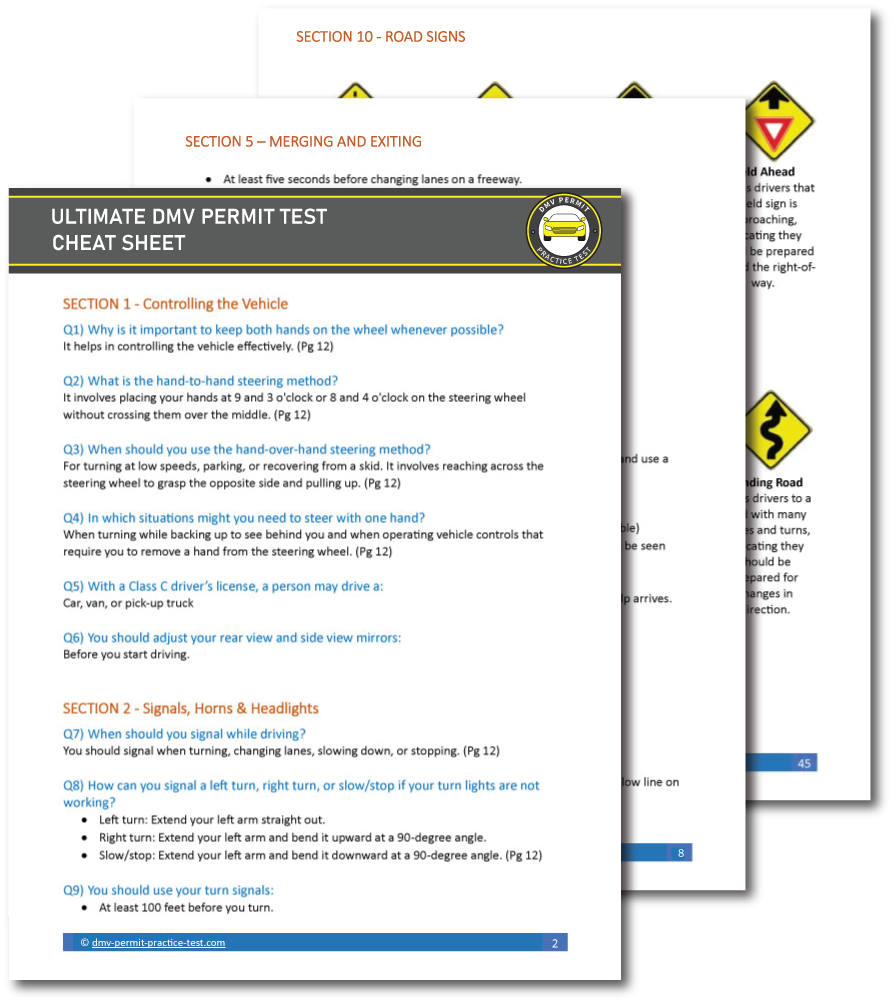
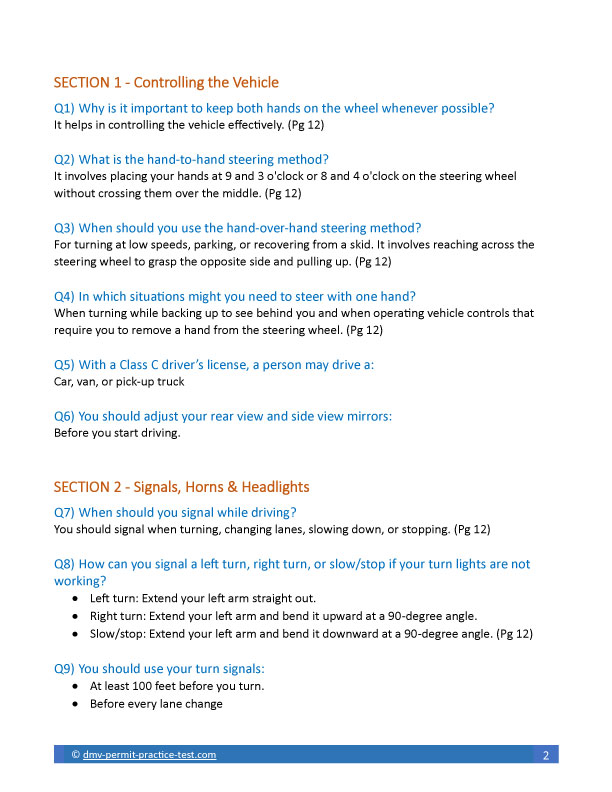
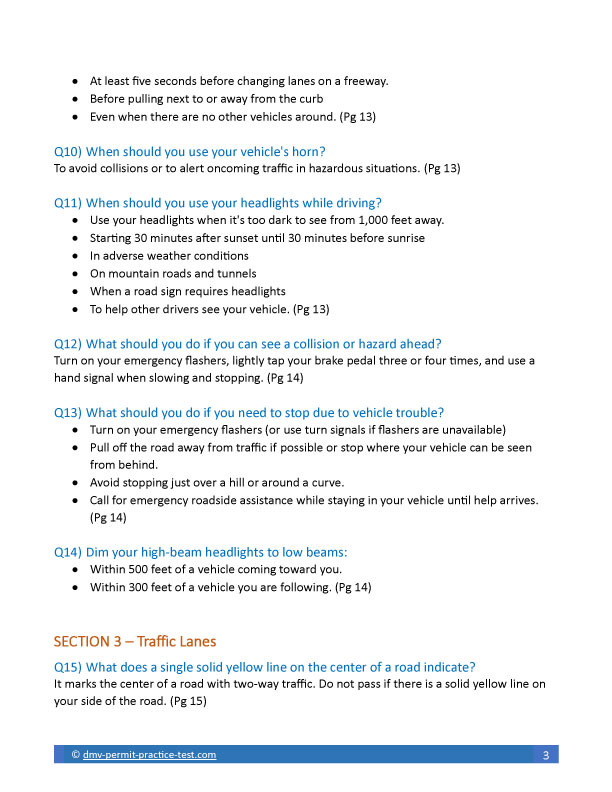
The California practice permit tests and cheat sheets you will find here are perfect for your California Learners Permit, California Driver’s License, California Senior Citizens’ Refresher Test, and your CA Driver’s License Renewal. All questions are from actual DMV administered written permit tests that are submitted by your peers. The written portion of the official DMV test will cover information from the California Driver Handbook. Questions will be based on rules of the road, traffic signs, and driving laws.
CA DMV Permit Exam at a Glance
You can expect to see 46 questions on your CA DMV exam. You must get 38 answers correct to pass your test if you are under the age of 18. If you are over the age of 18 your test will be 36 questions long and you must get 30 correct to pass. Each represents an accuracy score of 83.3%. You must be a minimum of 15.5 years old to apply and take your DMV written test. The permit test at the California DMV costs $38.